2026 · Japan resume format · 履歴書 / 職務経歴書
Free Rirekisho Builder
Build both documents Japanese employers expect — the gridded rirekisho and the narrative shokumu keirekisho — with formal, ATS-friendly templates. Free to download.
Rirekisho & Shokumu Keirekisho Templates
One template for the formal gridded rirekisho, one for the narrative shokumu keirekisho — the two documents Japanese employers expect together. Pick one and edit it free.
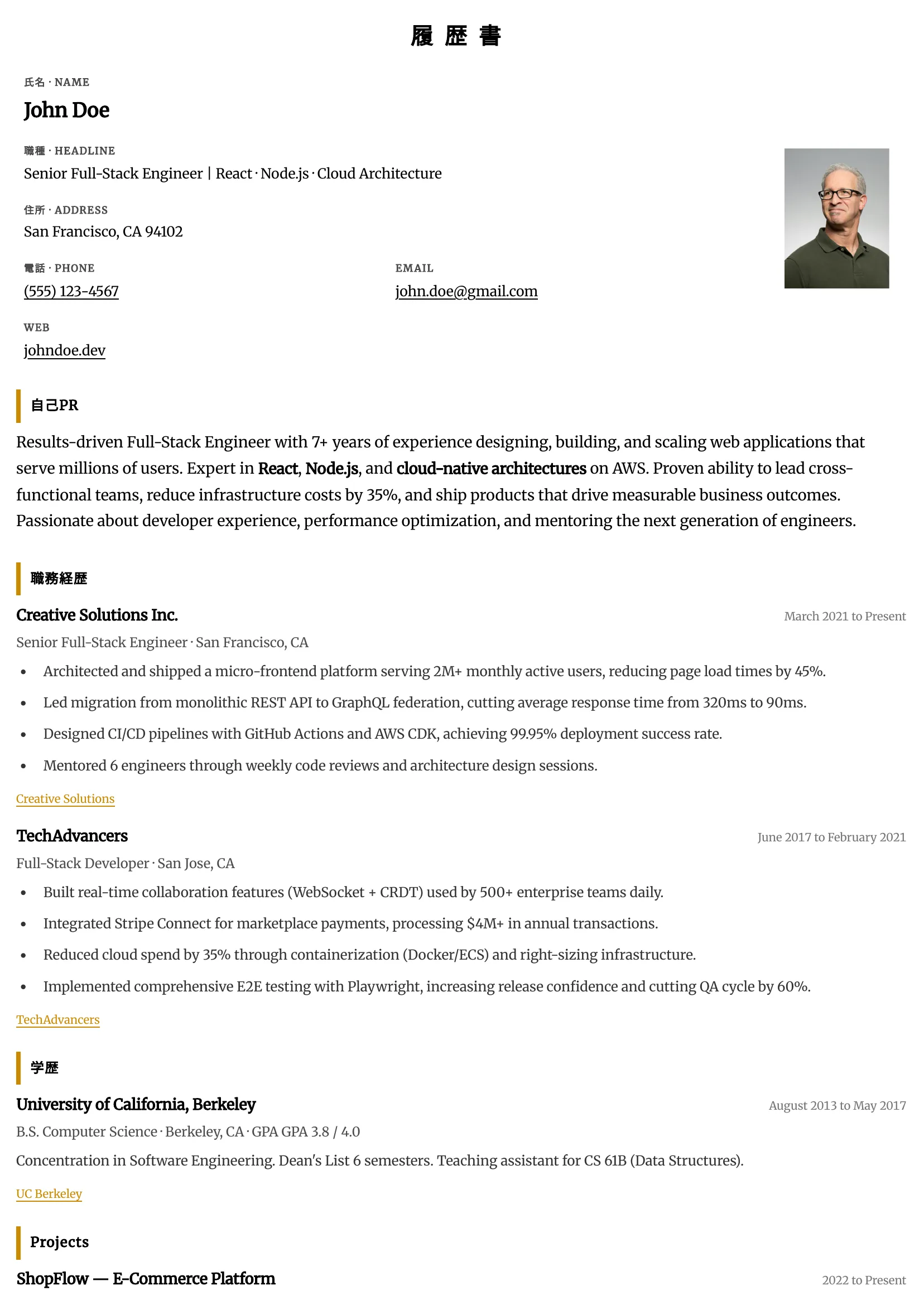
Rirekisho
Japanese 履歴書 (rirekisho) format. Bordered grid cells house every personal-data field with a photo cell top-right; bilingual section labels.
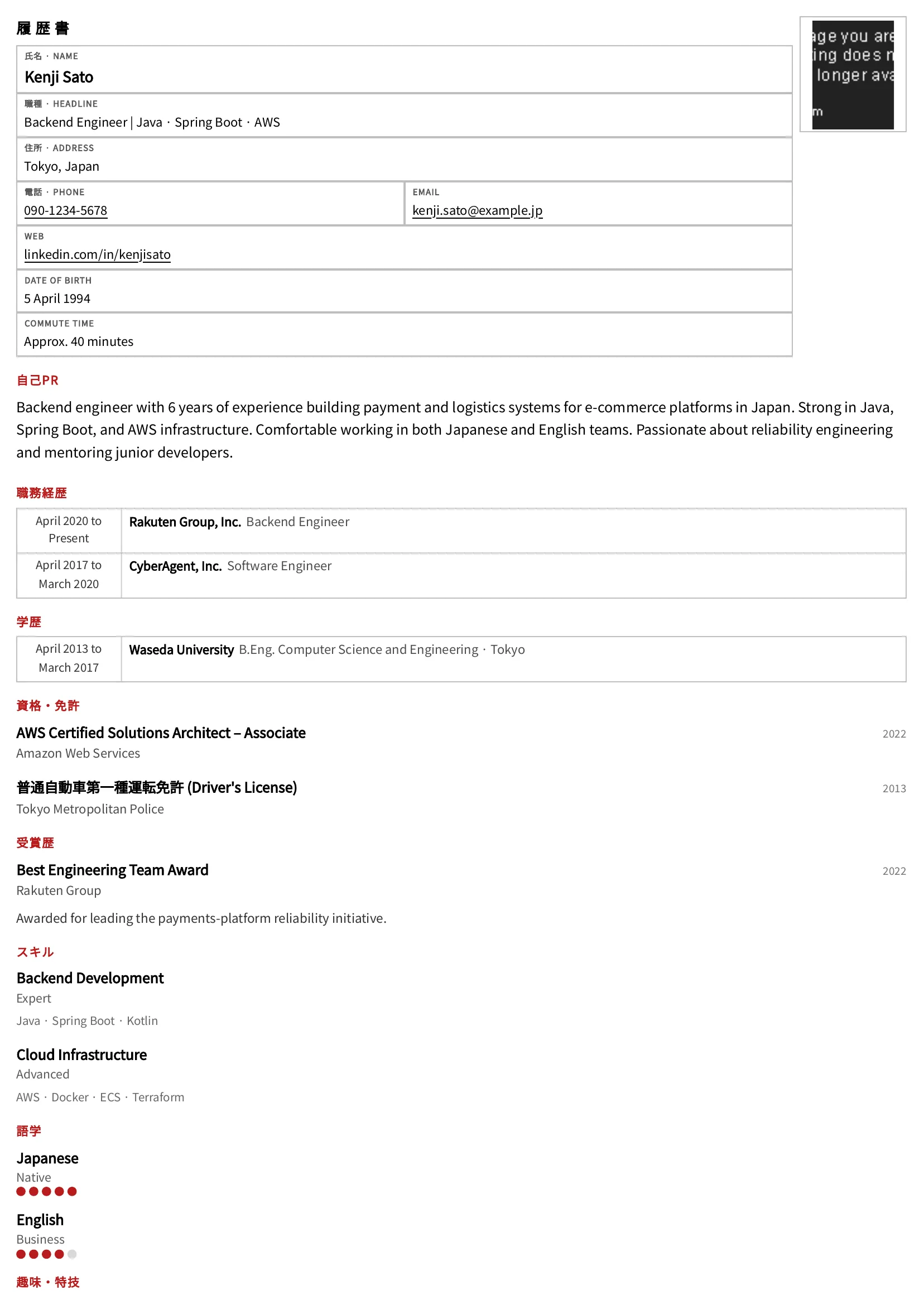
Rirekisho Compact
Single-page, ultra-ATS-safe rirekisho for shinsotsu (new-graduate) and early-career applications. Skips the heavy grid in favor of plain labeled rows while keeping the required photo box, so it stays maximally parseable.
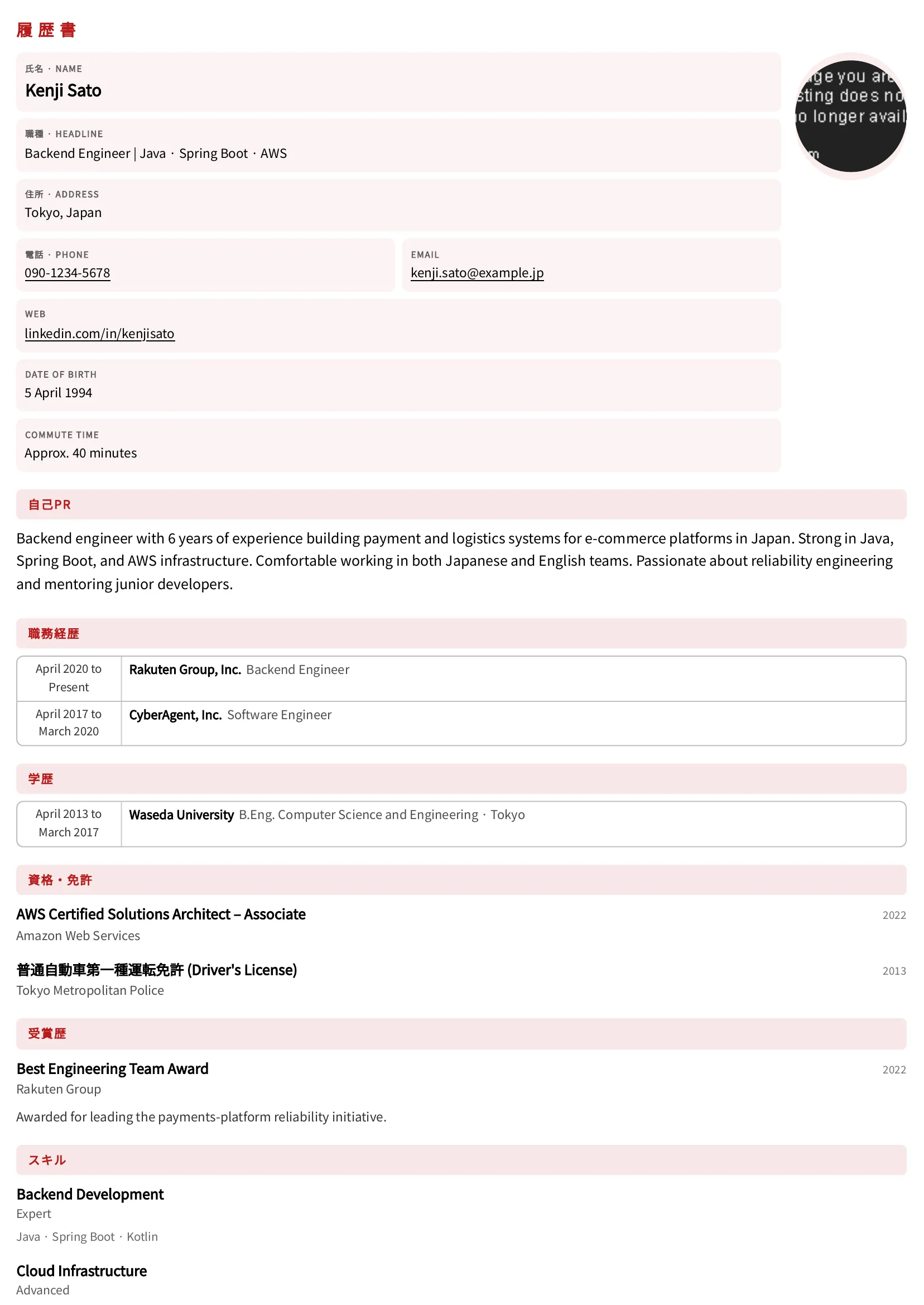
Rirekisho Modern
A softer, more polished rirekisho — rounded tinted cards replace the hard-bordered JIS grid, with a circular photo frame. Keeps the personal-data structure Japanese employers expect while reading as more contemporary for experienced-hire applications.
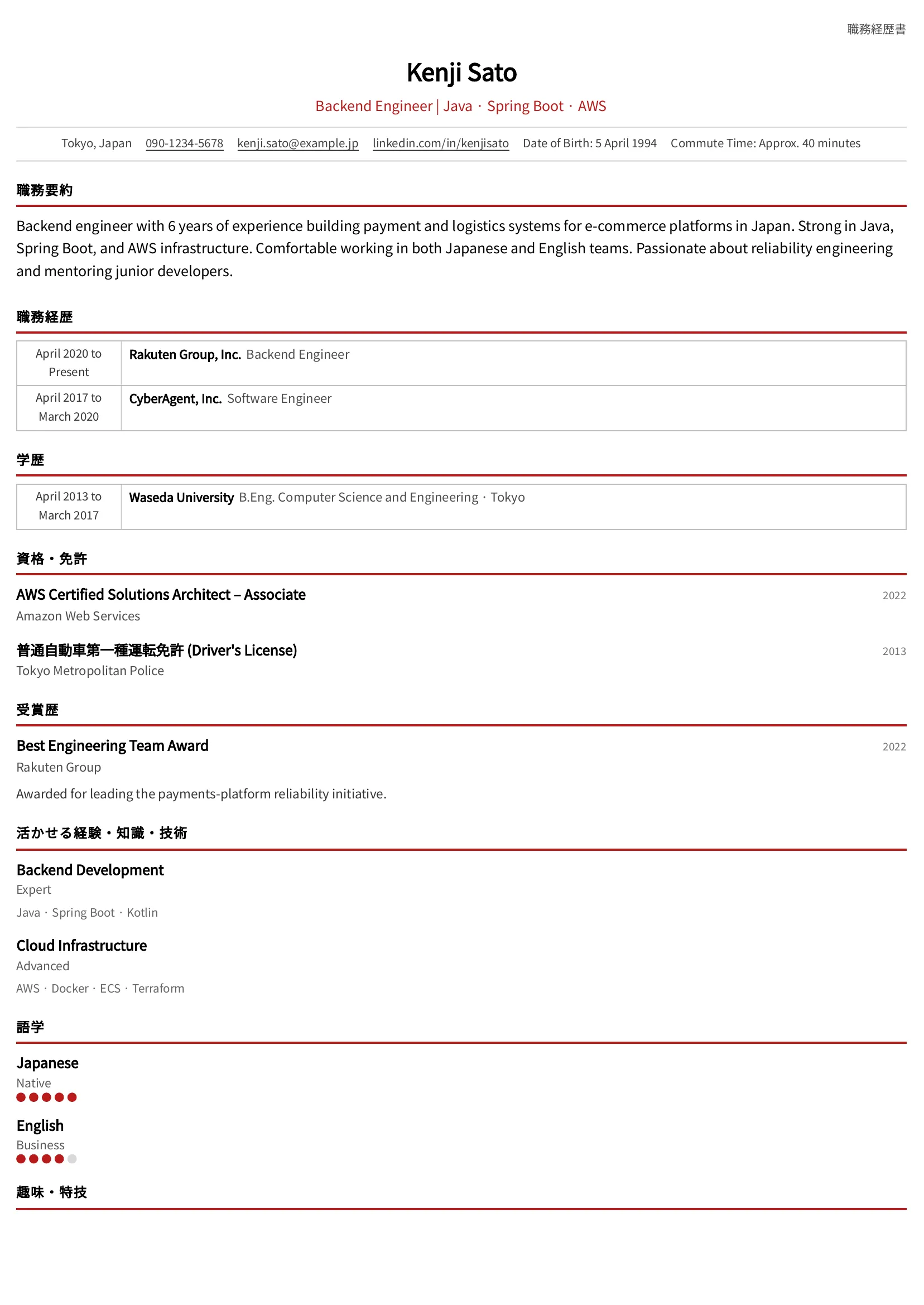
Shokumu Keirekisho
Japanese 職務経歴書 (shokumu keirekisho) — the career-history document submitted alongside the rirekisho. No photo or personal-data grid; a clean, narrative single column for work history, self-PR, and skills, matching what Japanese employers expect as the companion document.
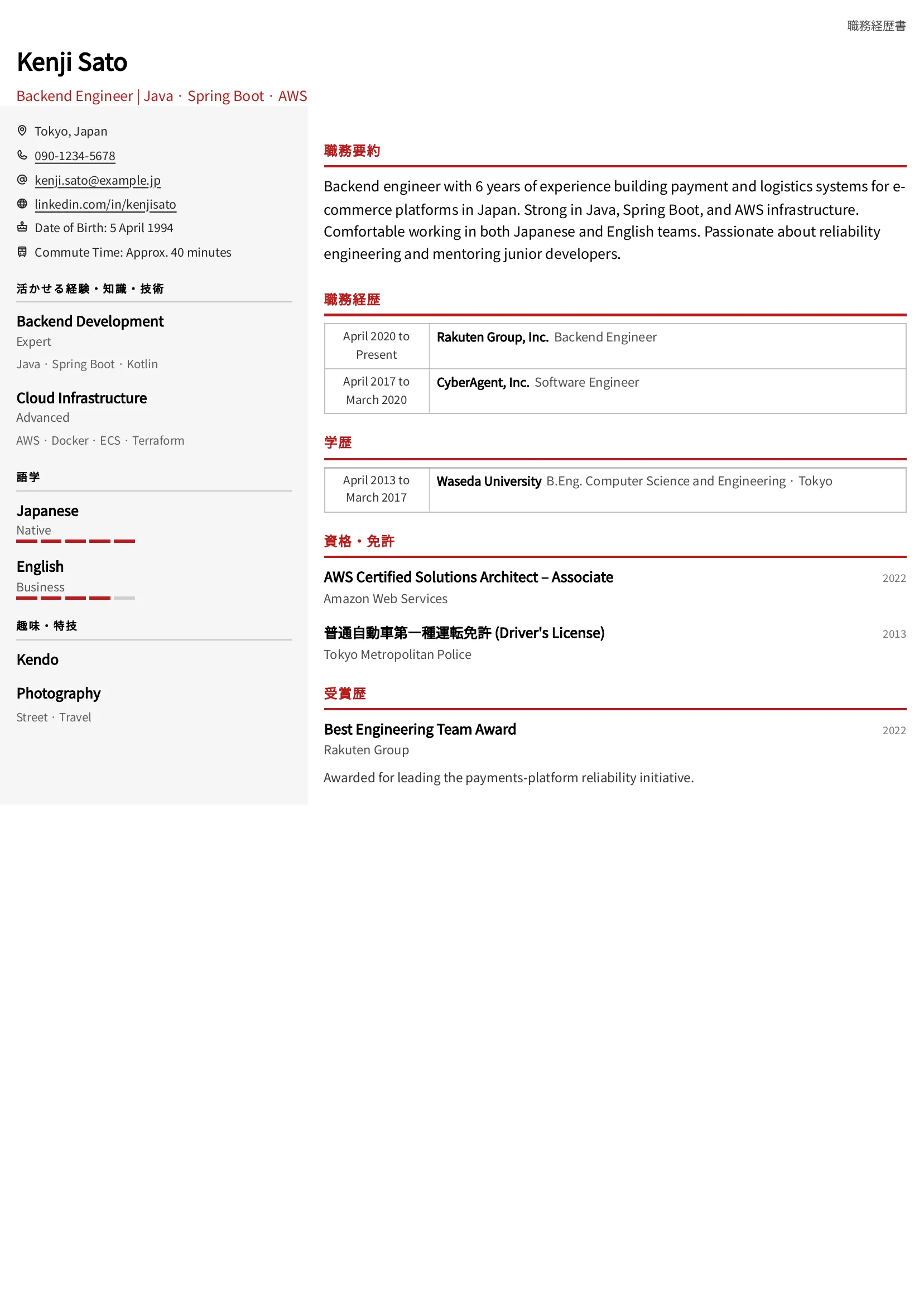
Shokumu Keirekisho Sidebar
Two-column shokumu keirekisho: a left sidebar rates skills, languages, and self-PR strengths, while the right column carries the narrative career history. No photo, matching the authentic companion-document convention, with more visual structure than a single column.
A Real Rirekisho Example
A backend engineer's rirekisho built for a Tokyo-based role — photo, JIS-style personal-data grid, and bordered work-history table filled in exactly as a real applicant would.
履歴書

自己PR
Backend engineer with 6 years of experience building payment and logistics systems for e-commerce platforms in Japan. Strong in Java, Spring Boot, and AWS infrastructure. Comfortable working in both Japanese and English teams. Passionate about reliability engineering and mentoring junior developers.
職務経歴
学歴
資格・免許
受賞歴
スキル
Java · Spring Boot · Kotlin
AWS · Docker · ECS · Terraform
語学
趣味・特技
Street · Travel
Two Documents, One Application
Japan's job-application convention is unlike almost anywhere else: most professional applications require two separate documents, each with its own format and purpose.
Rirekisho (履歴書)
A formal, gridded personal-history form: photo, contact details, education, and work history listed in fixed table cells. Required for almost every application in Japan.
Shokumu Keirekisho (職務経歴書)
A free-form career-history document — no photo, no grid — that goes into detail on your work experience, achievements, and self-PR. Expected alongside the rirekisho for most professional and mid-career roles.
The Rirekisho Format at a Glance
Photo required (rirekisho only)
A recent, formal photo (3x4cm, plain background) is mandatory on the rirekisho. The shokumu keirekisho has no photo.
Gridded personal data
The rirekisho uses bordered table cells for every personal-data field — name, address, education, work history — reflecting Japan's emphasis on formality and precision.
Date of writing
Both documents are typically dated on the day of submission, in the Japanese era or Western calendar depending on the employer's convention.
Length
Rirekisho is usually one to two pages; shokumu keirekisho runs one to three pages depending on career length.
Rirekisho — Frequently Asked Questions
What is a rirekisho?
Rirekisho (履歴書) is Japan's standard personal-history CV — a formal, gridded form covering personal details, education, and work history, with a photo. It's required for nearly every job application in Japan.
Do I need both a rirekisho and a shokumu keirekisho?
For most professional and mid-career roles, yes. The rirekisho covers your personal and educational background; the shokumu keirekisho (職務経歴書) is a separate, narrative document detailing your work experience and achievements. Entry-level and part-time applications sometimes only require the rirekisho.
Do I need a photo on a Japanese resume?
Yes, on the rirekisho — a recent, formal photo is expected, usually 3x4cm against a plain background. The shokumu keirekisho does not include a photo.
Is the rirekisho builder free?
Yes. Building and downloading both the rirekisho and shokumu keirekisho as PDFs with MyLiveCV is free.
Build Your Rirekisho Free
Create formal, ATS-friendly rirekisho and shokumu keirekisho documents in minutes — and download them as PDFs.